
In older technologies about 0.18um and larger, drawing 45 degree angles were common in metal, OD and poly layers. The 45 angle was often used when we wanted to pack something in tight like a core cell or pitch layout.
There was an interesting application of the 45 degree gate in the ESD, used to compensate for bird’s beak effect.
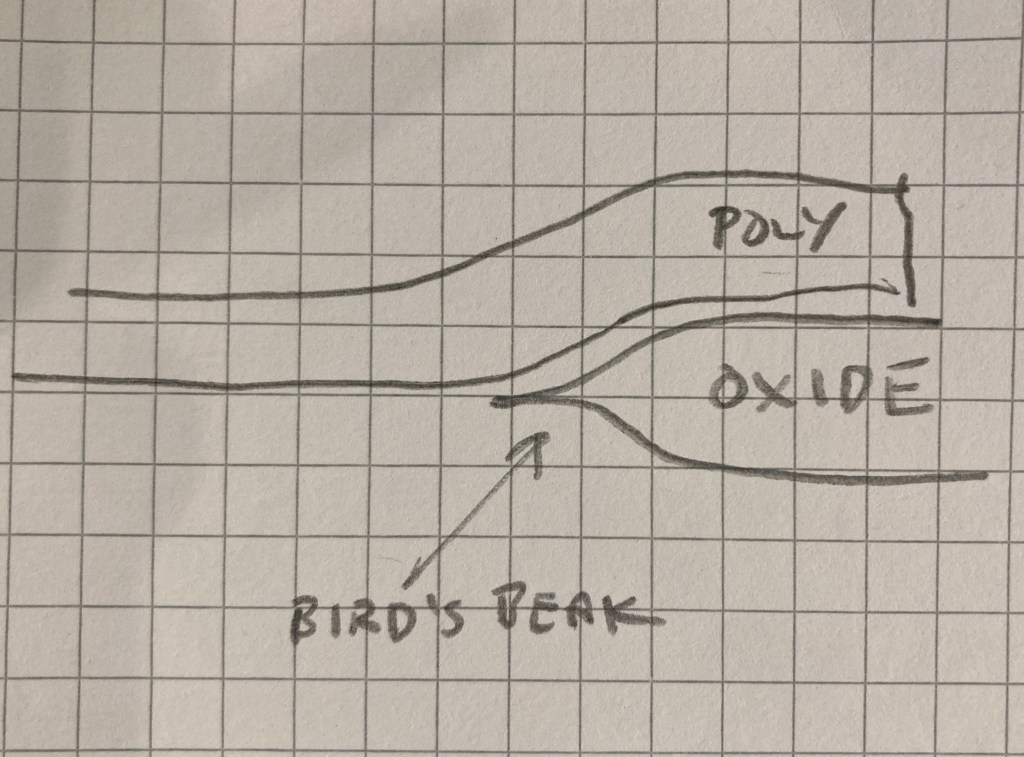
Using a CMOS gate as an example, bird’s beak is a phenomena that occurs at the edge of an oxide layer where it meets an OD region. The CMOS gate poly transitions across a bird’s beak region when it is deposited and the poly becomes subject to weakness or thinning. This may become a greater concern if the IO/ESD gate length is drawn at less than minimum recommended rule.
The gate extension dimensions may be the minimum recommended rule and a transition would occur as the poly transitions to gate. See illustration below (position of 45 degree angle in relation to the OD/gate border are approximations, not intended as a recommendation).
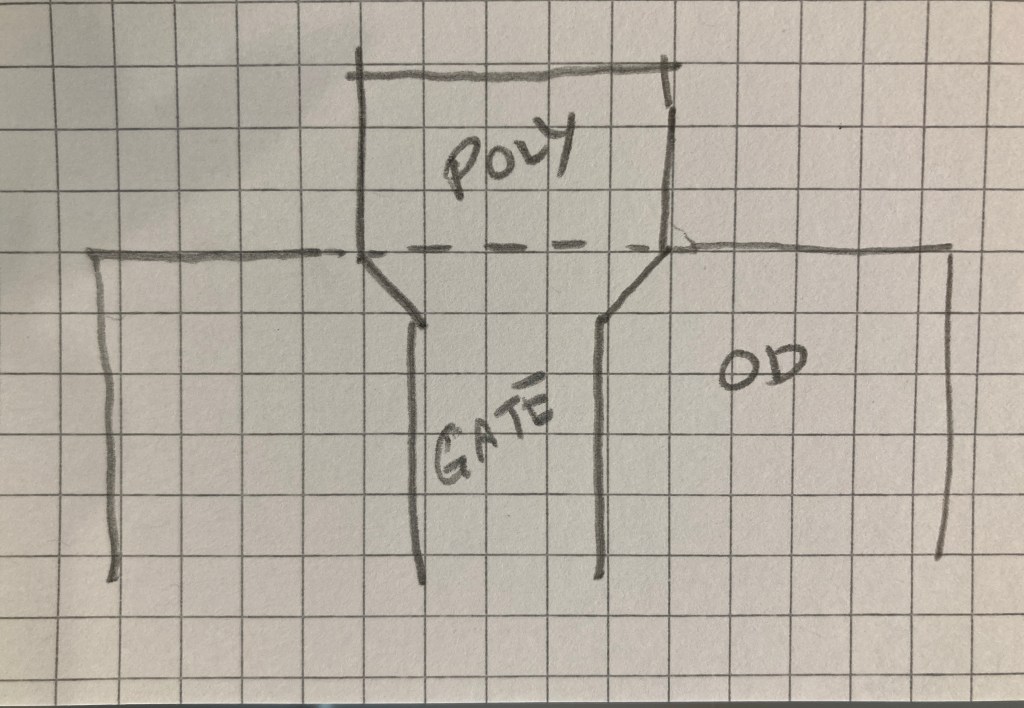
This would cause an LVS mismatch unless it is compensated for in the tolerance levels or otherwise.
To remain consistent, for ease of adjustment and matching, these modified gates must be in a repeated cell and be symmetrical at both ends of the gate.
***
The most disturbing thing our engineering group saw when going out to lunch was a humungous earthworm tucked into a leaf of a piece of bok choy. It was dead of course, probably medium rare. The waiter’s treated us like it was a common occurrence and didn’t even offer any comps. We were too nice.
The only thing that would have been worse? Half an earthworm.
***
Feel free to Like, Share, Follow, and Comment
CKY
***
Copyright © 2023 Challen Yee / ICLayout.blog Some Rights Reserved

 IC Layout
Leave a comment